Preface
As mentioned in my maiden effort to compose and publish my first play five years ago, I recently made the most unexpected discovery of some long-forgotten, more-than-three-decades-old files containing my first two attempts at writing amateur plays. After many revisions these became my two published plays: Say It With Ang Pows (Red Packets) and, now reproduced in this blog article, To Catch a High Flyer.
You can well imagine the joy this discovery brought me. After revisiting both plays and making many amendments, I present my second play to you and hope you will enjoy it despite its highly amateurish presentation.
To Catch a High Flyer
A one-act play
Setting
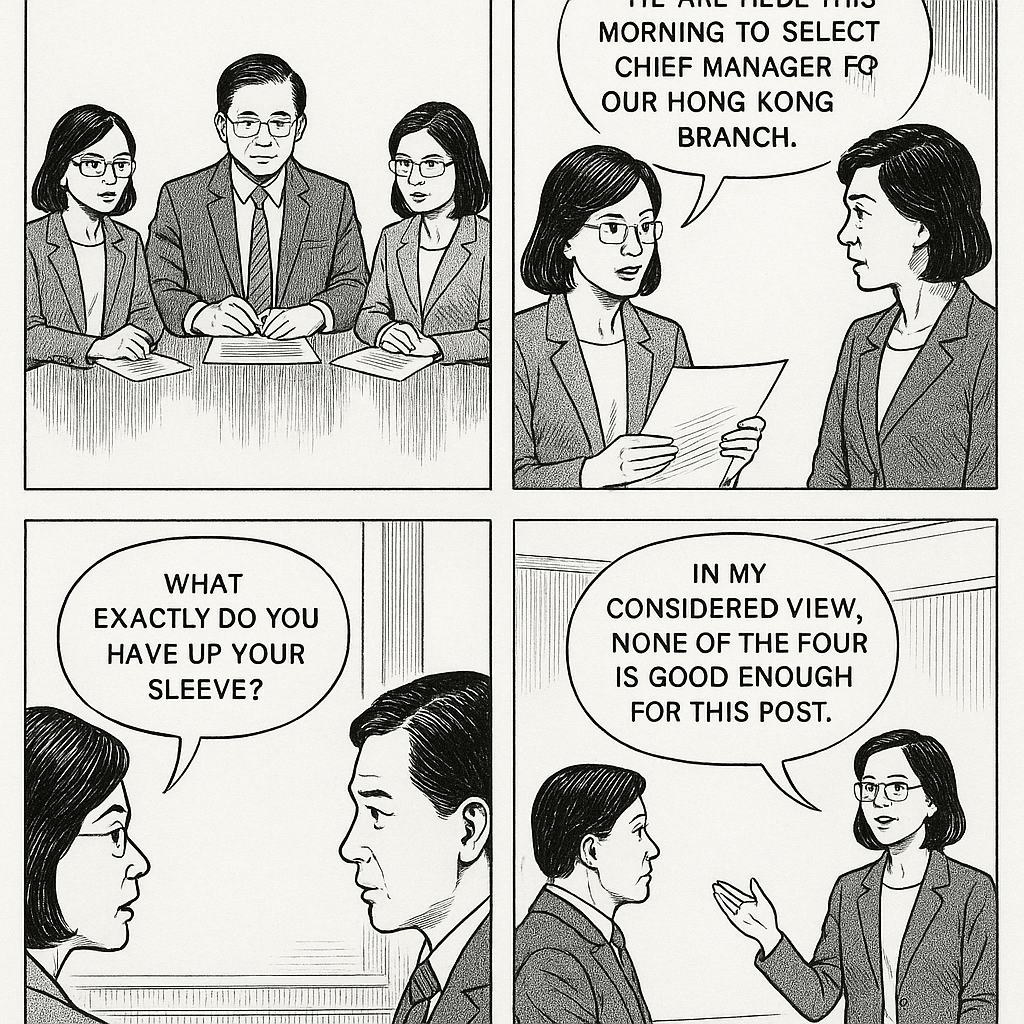
A meeting room in the head office of a reputable foreign bank in Singapore. The bank has branches in several major Asian cities. Seated at the head of the table is the General Manager, Mr David Chin. To his right is the Chief Personnel Manager, Mrs Audrey Wong; to his left sits Ms Irene Lim, a highly respected management consultant from an international consulting firm who is acting as assessor. Their task is to select the best candidate to head the bank’s major branch operation in Hong Kong.
The play opens with the trio studying the dossiers of the shortlisted candidates, carefully prepared by Mrs Wong and her senior staff.
Dialogue
Mrs Wong: We are here this morning to select the Chief Manager for our Hong Kong branch. The position was advertised in Singapore and Hong Kong, and 85 candidates applied—mostly from those two places, with several from elsewhere in Southeast Asia. Many hold degrees from leading universities in Singapore, Hong Kong, and overseas, and have strong work experience. Only four have been shortlisted. They all possess relevant banking experience and outstanding academic credentials, which will make our final choice extremely difficult.
Ms Lim: I notice that one candidate currently works in your head office here in Singapore. Is it the bank’s policy to give an internal applicant priority?
Mrs Wong: Everything else being equal, yes.
Ms Lim: In practice that seldom happens, as candidates invariably differ in the qualities a job requires. Do you both agree?
Mrs Wong: May I continue?—(she shows a trace of impatience)—except for the internal candidate, who is single and female, the other three are married men.
Mr Chin: May I interrupt? I would like your views on the suitability of a woman for a role that involves a fair amount of client fraternising—mostly with male clients—and evening entertainment.
Mrs Wong: That is not an insurmountable problem. Our internal applicant is sociable and charming; she can hold her own with male clients. She can also delegate social functions to her Assistant Manager, who is a sociable male colleague, when necessary.
Mr Chin: Please don’t think I’m old-fashioned, but I can’t help feeling a man would be more suitable. I, for one, find it awkward to discuss serious business matters with a lady.
Mrs Wong: That is a side of you I had never seen before!
Mr Chin: Oh, don’t get me wrong. I pride myself on being broad-minded, yet serious matters can still feel awkward…
Mrs Wong: Ms Lim, do you agree with Mr Chin?
Ms Lim: I would prefer to reserve my position for now.
Mr Chin: What of the other three candidates, then?
Mrs Wong: Candidate No. 1 appears quite suitable but has high salary expectations. To hire him, we would have to offer terms at least one rung above this position. Before long, he might want to take a crack at your job, Mr Chin.
(Laughter all round.)
Mr Chin: He seems the type who hops from job to job for higher pay—hardly ideal for senior management.
Mrs Wong: Ms Lim, do you agree?
Ms Lim: Again, I reserve judgment.
Mr Chin: And the remaining two?
Mrs Wong: One is a well-known personality at MAS (the Monetary Authority of Singapore). We might incur MAS’s displeasure if we poach him.
Mr Chin: A hard case. Strictly speaking, the “no-poaching” gentleman’s agreement with the Government doesn’t apply when a public servant applies on his own initiative; nevertheless, I would rather not cross swords with MAS’s formidable Managing Director.
Mrs Wong: Nothing is beyond your ingenuity when you want a superstar, I’m sure. Any view, Ms Lim? (Her tone suggests she is not keen to hear one.)
Ms Lim: I’ll give my view after we discuss the last candidate. (Her tone remains professionally calm.)
Mrs Wong: The last candidate is no ordinary one. Besides his impressive credentials, his father is a substantial and highly valued customer of our bank.
Mr Chin: We shouldn’t be unduly swayed by that, should we?
Mrs Wong: Certainly not, but I thought it worth mentioning. (She smiles knowingly.)
Before we proceed to rank the candidates—as is our usual practice—perhaps we should hear whether Ms Lim has any unusual insights into them.
Ms Lim: Thank you, Mrs Wong. Ranking may suffice in a normal case, but to catch a high flyer, we should adopt a bolder approach.
Mrs Wong: What exactly do you have up your sleeve?
Mr Chin: Indeed, do enlighten us; I’m intrigued.
Ms Lim: (With a triumphant smile, about to disclose her coup de grâce.) In my considered view, none of the four is good enough for this post.
Mrs Wong: What can you possibly be thinking? I don’t understand.
Mr Chin: Please let her continue. I’m as curious as Mrs Wong.
Ms Lim: The reason is simple. Our experience shows that real high flyers never apply for a job suitable for them; if they were to apply and fail, their position becomes untenable. They must be invited and convinced it is in their interest to accept.
Mrs Wong: But no one would know—they apply in strictest confidence.
Ms Lim: In theory, yes—but such things often leak. I once saw a boss and his star subordinate meet in a waiting room, each unknowingly applying for the same job; the subordinate got it, and the boss became a laughing-stock and resigned.
In our case the four candidates are strong, but none is that exceptional high flyer.
Mr Chin: I fail to see your logic; we agree they’re excellent and from different institutions.
Ms Lim: Not guilty, I’m afraid. They will do, yes, but what you want is someone who will bring distinction to the role.
Mrs Wong: I can’t say I’m impressed.
Mr Chin: (Confused.) Never mind that: what do you recommend?
Ms Lim: I know someone who would be ideal and likely to accept if invited.
Mr Chin: I’m prepared to trust you, Ms Lim, given your track record. Can you sound out this mysterious candidate?

Mrs Wong: I’ll go along, though this method is alien to my training.
Mr Chin: Shall we reject the four applicants immediately and await your news?
Ms Lim: Yes. The genuine high flyer never applies; he must be invited.
(The earlier exchange between Ms Lim, Mrs Wong, and Mr Chin repeats in a condensed form. It has been retained here but streamlined for clarity.)
Ms Lim: Approaching him directly would be unwise, but I can enlist Dr Ma, his former university mate and close friend, to act as intermediary.
The candidate—Dr Yin, in his mid-30s—is a Senior Economics Lecturer, familiar with banking, originally from Hong Kong but now a Singapore citizen. With Dr Ma’s persuasion, I’m confident he’ll accept, subject to some refinements of terms.
Mr Chin: Excellent. We needn’t trouble ourselves with the four applicants.
Mrs Wong: Agreed. We await your good news, Ms Lim.
Ms Lim: Very well. My recommendation echoes the time-tested principles of Parkinson’s Law, themselves derived from ancient Chinese civil-service selection techniques.
Mr Chin: You’ve opened my eyes: those who apply rarely get it; the best wait to be invited.
Ms Lim: Life’s little irony. Thank you both for your confidence; it won’t be misplaced.
(Three weeks later.)
Ms Lim informs Mr Chin and Mrs Wong that Dr Yin wishes to meet them. At the meeting Dr Yin proposes that, provided the bank increases his annual bonus when year-end results warrant it and grants extra leave to visit his family in Singapore, he will accept.
Both Mr Chin and Mrs Wong gladly agree. Dr Yin will take up the Hong Kong post in two months.
Ms Lim is heartily congratulated by the bank and her consulting firm for another head-hunting success.
Dr Yin excels. After more than eight years in Hong Kong, he succeeds Mr Chin in Singapore when the latter is promoted to a senior post at the bank’s London head office.
— The End —
(All names of persons, banking institutions, and consulting firms are fictitious and bear no relation to real individuals or entities.)
— Lam Pin Foo
 Lam Pin Foo